Christopher Nolan’s Most Ambitious Journey Yet.
After reshaping genres with films like Interstellar and Oppenheimer, Christopher Nolan is now stepping into the world of ancient mythology with The Odyssey. Adapting The Odyssey by Homer, Nolan brings the legendary tale of Odysseus’ perilous journey home after the Trojan War to the big screen on a scale rarely attempted in modern cinema. Known for blending intellectual depth with grand spectacle, Nolan’s take promises not just a visual epic, but an emotionally grounded exploration of identity, survival, and the longing for home.
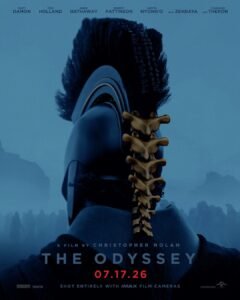
Starring Matt Damon as Odysseus, alongside Anne Hathaway and Tom Holland, the film is said to combine large-scale practical film making with immersive IMAX cinematography
. From storm-torn seas to mythical encounters with gods and monsters, the narrative is expected to balance breathtaking adventure with deeply personal stakes. Nolan’s signature storytelling style — nonlinear structure, emotional tension, and philosophical undertones — could transform this ancient poem into a modern cinematic event.
More than just another historical adaptation, The Odyssey feels positioned as a cultural moment , a bridge between timeless literature and contemporary blockbuster film making. If Nolan succeeds in capturing both the mythic grandeur and the human vulnerability at the heart of Odysseus’ journey, this could stand alongside his most celebrated works. For audiences who crave spectacle with substance, The Odyssey might just be the epic experience of 2026.
The Odyssey is scheduled to be released in theaters in the United States on July 17, 2026, distributed by Universal Pictures. The film will be available in IMAX, IMAX 70mm film, and other premium large formats (PLFs), emphasizing Christopher Nolan’s commitment to delivering a grand theatrical experience. In a highly unusual and bold move, tickets for select IMAX 70mm screenings were released on July 17, 2025 — a full year before the film’s release. This early ticket launch was considered unprecedented for a major studio release. Within just 12 hours, several screenings sold out, including half of the 22 IMAX 70mm locations available in the United States. The overwhelming response immediately signaled massive audience anticipation.The film was later ranked as the most anticipated movie of 2026 by IMDb. Industry analysts have also made strong box office predictions. Variety suggested that The Odyssey could become the highest-grossing film of 2026, partly due to its strong early ticket sales. Meanwhile, TheWrap predicted that it might even surpass The Dark Knight and The Dark Knight Rises to become Christopher Nolan’s highest-grossing film ever.
FILMING
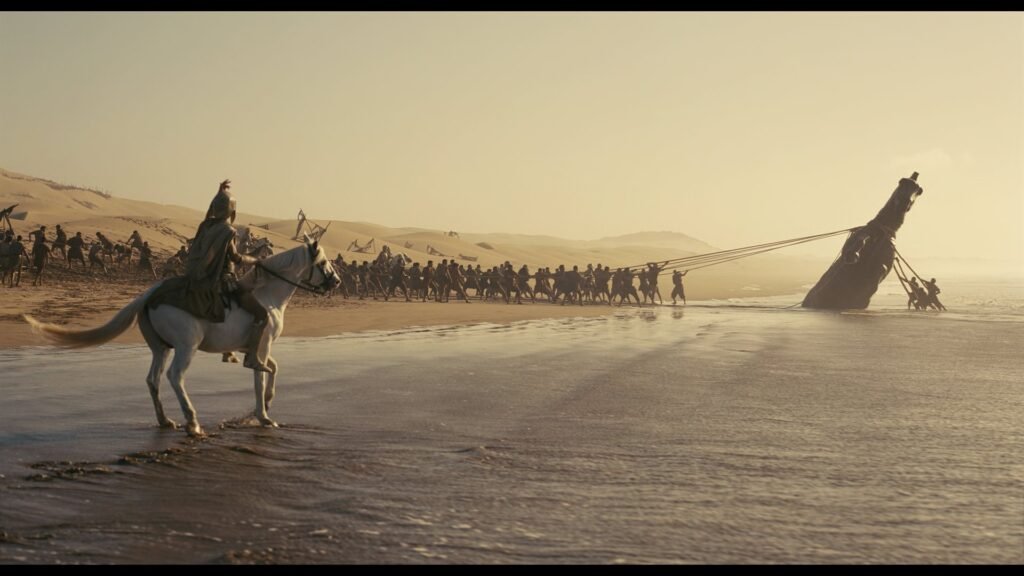
Nolan aimed to embrace the physicality of the real world by filming extensively on location. He believed that capturing real landscapes would enhance the storytelling and convey how difficult such ancient journeys would have been. The constantly shifting weather conditions added further authenticity, presenting real challenges that complemented the film’s raw, immersive approach.

Filming began in late February at the village of Aït Benhaddou near Ouarzazate, Morocco, which was used to depict the city of Troy at the end of the Trojan War in an opening sequence. Additional scenes in Morocco were shot in Essaouira and Marrakesh. Production then moved to the Peloponnese region of Greece, including Pylos, Methoni Castle, Almyrolakkos Beach in Yialova, Nestor’s Cave at Voidokilia Beach, and an archaeological palace site in Acrocorinth, Corinth. Scenes featuring the Cyclops Polyphemus were filmed in these areas. The production partnered with Faliro House Productions’ NAF subsidiary during its three-week Greek schedule, which included a substantial cash rebate.
By late March, filming shifted to the Aegadian Islands in Sicily, Italy, particularly on the island of Favignana, traditionally associated with the “goat island” described in Homer’s poem. Maritime filming then continued across the Aeolian Islands , Lipari, Basiluzzo, and Vulcano — for sequences set on the mythological island of Aeolia. These shoots were conducted under specific local safeguarding regulations. For ocean sequences, the production utilized the Draken Harald Hårfagre, the world’s largest modern Viking longship, which was adapted to represent an ancient Greek warship commanded by Odysseus and his crew. Nolan described filming at sea as a deeply primal and immersive experience.
Midway through production, the team briefly returned to Los Angeles to film on the only constructed soundstage set used in the entire project. In early June, filming moved to Findlater Castle in Moray, Scotland. Later in June, production partnered with Truenorth in remote areas of Iceland, including Landeyjahöfn harbour, Hjörleifshöfði mountain, the Markarfljót river, and the Snæfellsnes peninsula. These stark black sand beaches were primarily used to depict the Greek underworld of Hades. The team then returned to Scotland for scenes at Buckie Harbour along the Moray Firth coast and at Sunnyside Beach near Cullen, Moray. Additional filming occurred in Culbin Forest before returning once again to Findlater Castle. Charlize Theron filmed her scenes as Circe during the final weeks of July.
Some scenes were also shot at the White Dune near the city of Dakhla in Western Sahara, a territory under Moroccan control since 1975. This decision drew criticism from the UN-recognized Polisario Front and organizers of the Sahara International Film Festival, who accused the production of whitewashing Morocco’s colonial presence in the region. They called for the removal of the scenes filmed there or for consent to be obtained from representatives of the Sahrawi people. Several prominent actors, filmmakers, and human rights advocates supported the statement. However, filming in the territory had already concluded by the time the criticism emerged. Meanwhile, the Moroccan Cinematographic Center welcomed the production, calling it significant for Morocco’s film industry and noting that it was the first major American film shot in that region.
Additional filming also took place in Malta before production concluded in Los Angeles. Some scenes were also planned in the United Kingdom and Ireland.
Explore More Cinema Analysis
 Toxic – Yash’s Darkest Film Yet
Toxic: Why Yash’s Next Film Is One of the Most Anticipated Movies After the massive…
 Inside ‘Michael’ (2026)
'Inside the Most Talked-About Michael Jackson Biopic' Few artists in history have shaped popular culture…
 Jana Nayagan Censor Trouble Delays Vijay Film
Actor Vijay’s film Jana Nayagan has become one of the most talked-about projects in Tamil…
 Why 'The Godfather' (1972) Is Still the Greatest Gangster Film Ever Made
'The Godfather' (1972) – A Masterclass in Crime Cinema Few films in cinema history have…