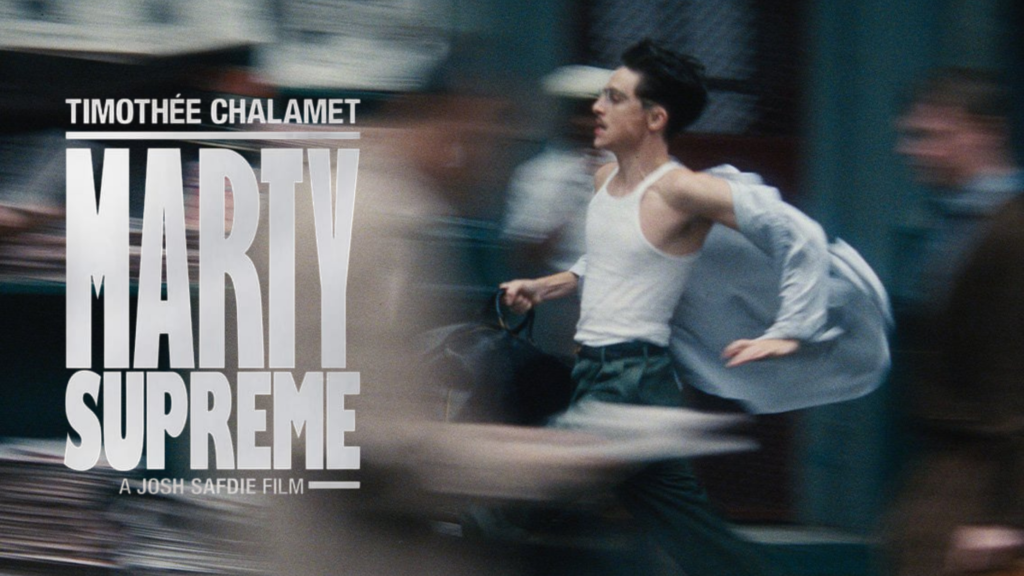
Marty Supreme Review —Ambition has always been cinema’s favorite obsession. From boxers chasing titles to musicians chasing immortality, the story of greatness often begins with hunger. Josh Sa fdie’s Marty Supreme takes that familiar foundation and reshapes it into something volatile, intimate, and unexpectedly philosophical. Set against the restless backdrop of 1950s New York, the film follows Marty Mauser, a gifted but emotionally unstable table tennis prodigy determined to carve his name into history.
At first glance, the premise may sound unconventional — a serious sports drama about table tennis. But Safdie is not interested in novelty. He is interested in ego. In insecurity. In the quiet desperation that hides behind talent. This Marty Supreme Review makes one thing clear from the outset: the sport is merely the battleground. The real war unfolds inside Marty himself.
What unfolds over 150 minutes is not just the story of a rising athlete, but a meditation on entitlement, masculinity, and the myth of the American Dream. It is bold filmmaking — ambitious in scale, intimate in emotion, and fearless in character portrayal.
A Sports Drama That Redefines Intensity
Sports dramas often follow predictable emotional arcs — training struggles, humiliating defeat, triumphant comeback. Marty Supreme rejects that formula almost entirely. Instead of building toward a singular defining match, the film constructs tension through psychology. Every rally at the table becomes a reflection of Marty’s internal state. His precision mirrors his discipline; his recklessness reveals his insecurity.
Safdie treats table tennis not as a quirky hook, but as a cinematic arena worthy of grandeur. The matches are filmed with kinetic energy — tight close-ups on spinning paddles, rapid cuts between players’ eyes, beads of sweat under harsh lights. The sound design amplifies every strike, transforming the rhythm of the game into something almost musical. The intensity feels disproportionate in the best way possible — because to Marty, every point is existential.
This Marty Supreme Review must emphasize how successfully the film legitimizes its sport. There is no ironic distance, no wink to the audience suggesting the premise is absurd. Instead, Safdie presents competition as sacred ritual. The tension comes not from whether Marty wins, but from how he wins — and what it costs him emotionally.
By refusing cliché, the film elevates itself beyond traditional sports storytelling into psychological territory.
The American Dream and the Illusion of Entitlement
Beyond the physicality of competition, Marty Supreme interrogates ambition itself. Marty believes deeply — almost dangerously — in his own destiny. Raised in working-class surroundings, he sees talent as a ticket out, but he also sees recognition as something owed to him. That subtle distinction defines the emotional engine of the film.
Set in 1950s New York — a period often romanticized as an era of order and opportunity — the film strips away nostalgia. The city is raw, noisy, competitive. Success is not handed out; it is extracted. Safdie uses this historical context to expose the myth of the American Dream as something both motivating and corrosive. Marty’s drive pushes him forward, but it also isolates him.
This section of the Marty Supreme Review highlights the film’s most compelling question: does talent justify arrogance? Marty’s entitlement is never fully condemned, but neither is it excused. The screenplay allows his flaws to surface without softening them. He manipulates, lashes out, and distances himself from those who care about him. Yet beneath the bravado lies insecurity — the fear of irrelevance.
By the midpoint, the film transforms into something more than a sports narrative. It becomes a character study about ego colliding with reality. The rise feels exhilarating; the fall feels inevitable. And that inevitability is what gives the film its tragic undertone.
Timothée Chalamet’s Career-Defining Performance
No Marty Supreme Review can avoid the central truth: Timothée Chalamet anchors this film with astonishing control. His portrayal of Marty Mauser is volatile yet calculated, charismatic yet deeply flawed. Rather than leaning into vulnerability for sympathy, Chalamet embraces contradiction. He allows Marty to be unlikeable, impulsive, even cruel — and in doing so, makes him profoundly human.
What distinguishes this performance from Chalamet’s earlier work is its restraint. There are no grand emotional breakdowns engineered for awards reels. Instead, the performance operates in glances, in posture, in micro-expressions during matches. His body language shifts subtly as Marty’s confidence grows — shoulders straighter, gaze sharper. But when doubt creeps in, that posture collapses almost imperceptibly.
The transformation feels organic. It signals maturity in both actor and character. Chalamet understands that greatness on screen is often about tension — the tension between what a character projects and what they conceal.
By the final act, Marty is no longer simply an ambitious young man. He is someone confronting the consequences of his own mythology. Chalamet captures that realization with quiet devastation. If there is justice in awards season, this performance will be central to the conversation.
Supporting Performances and Safdie’s Controlled Chaos
While Chalamet commands attention, the supporting cast reinforces the emotional framework. Gwyneth Paltrow brings grounded subtlety to her role, embodying a stabilizing force in Marty’s turbulent world. Odessa A’zion offers sharp emotional counterbalance, refusing to be sidelined in Marty’s orbit. Their characters are not narrative accessories; they are moral mirrors.
Visually, Safdie’s direction oscillates between intimacy and frenzy. The handheld cinematography during matches generates anxiety, while quieter domestic scenes feel almost suffocating in their stillness. Editing choices create momentum without overwhelming clarity. The rhythm mirrors Marty’s mental state — bursts of brilliance punctuated by instability.
This portion of the Marty Supreme Review underscores how Safdie maintains thematic coherence despite tonal shifts. Even at 150 minutes, the film sustains narrative urgency. Scenes bleed into one another with restless energy, yet never lose emotional focus.
The world of Marty Supreme feels lived-in — crowded apartments, smoky tournament halls, rain-soaked streets. The aesthetic avoids romantic polish, favoring texture over nostalgia. That authenticity grounds the film’s larger philosophical ambitions.
Final Verdict – Marty Supreme Review
In conclusion, this Marty Supreme Review affirms the film as one of the year’s most ambitious character-driven dramas. It is bold without being indulgent, psychological without losing narrative propulsion. What begins as a sports story evolves into a meditation on ego, masculinity, and the fragile architecture of ambition.
Josh Safdie proves himself capable of balancing spectacle with introspection. Timothée Chalamet delivers a performance that feels transformative — a defining moment in a career already marked by promise.
Marty Supreme is not simply about table tennis. It is about the dangerous seduction of believing you are destined for greatness — and the humility required to truly earn it.
⭐ Rating: 4.5/5