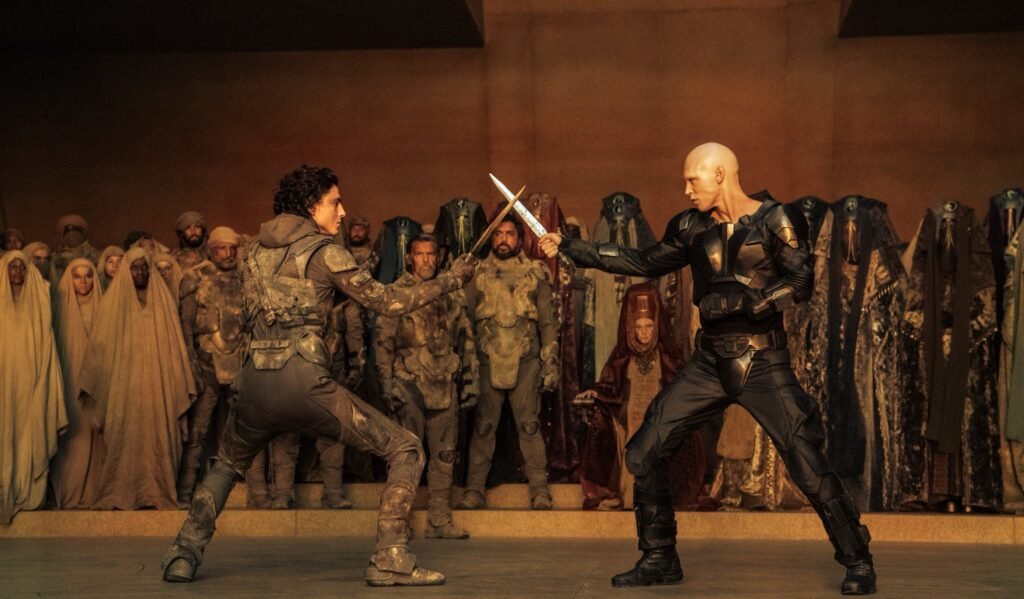
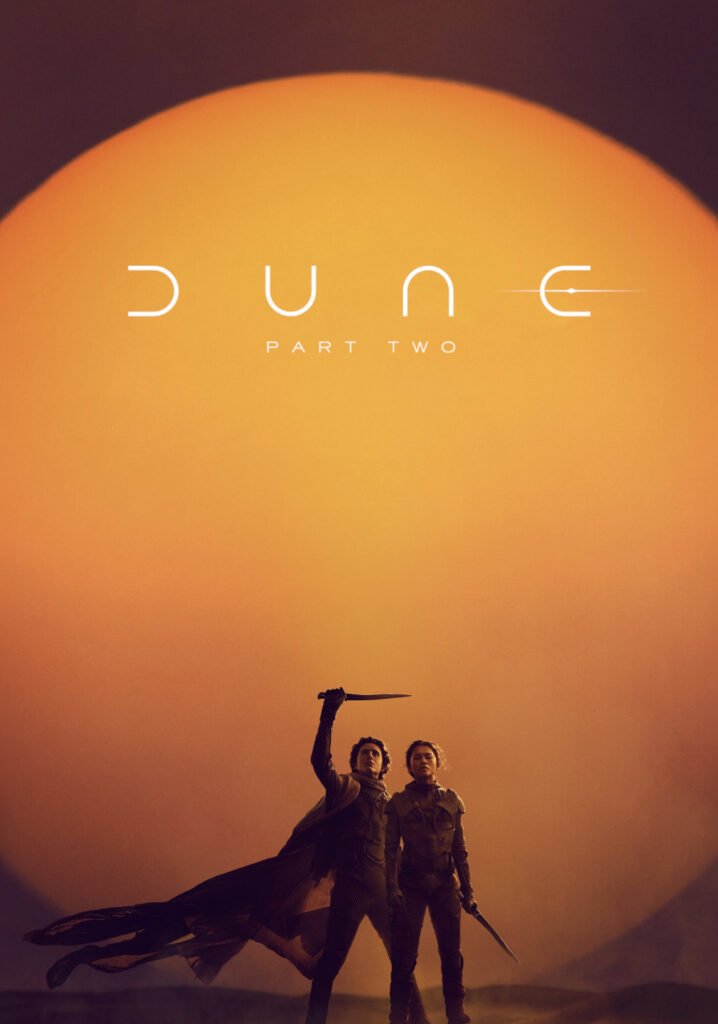
The Holy War Begins – Scale Beyond Imagination
“The Holy War Begins.” That line doesn’t just describe Dune: Part Two, it defines its entire energy. Denis Villeneuve returns with a sequel that doesn’t simply continue the story but expands it into something far more intense, layered, and emotionally charged. Where the first film was about survival and setup, this one is about transformation, consequence, and power.
From the very first frame, the film pulls you back into Arrakis with a sense of scale that feels almost overwhelming. The desert is no longer just a setting — it becomes a character in itself. The vastness, the silence, and the harshness of the environment are captured with stunning precision. Every wide shot feels monumental, yet there’s always an underlying intimacy in how the characters are placed within that space.
However, unlike the first film, which had a razor-sharp pace that never allowed you to disengage, Dune: Part Two takes its time. And while that patience allows the story to breathe and expand, it also introduces moments where the narrative feels slightly stretched. Certain sequences linger longer than they need to, slowing down the momentum that the film builds so effectively in other parts.
But even with these pacing issues, the scale and ambition of the film remain undeniable. This isn’t just a sequel — it’s a full evolution of the world Villeneuve has created.
From Survivor to Messiah — Paul Atreides’ Transformation
At the heart of the film lies Paul Atreides, and this is where Dune: Part Two truly shines. Timothée Chalamet delivers a performance that is far more commanding and layered compared to the first film. Paul is no longer just a young man trying to understand his destiny — he is now actively stepping into it.
The film explores his transformation from an outsider seeking refuge to a leader shaping the future. But what makes this journey compelling is the internal conflict that comes with it. Paul is aware of the consequences of his rise, yet he is pulled forward by forces that feel inevitable. This tension between choice and destiny becomes one of the film’s strongest emotional anchors.
His relationship with the Fremen further deepens this arc. Their belief in him as a messianic figure adds both strength and pressure to his character. The film subtly questions the idea of prophecy — is Paul fulfilling a destiny, or is he being shaped by the expectations around him? This ambiguity adds a philosophical layer that elevates the narrative beyond just politics and war.
A Visual and Sonic Masterpiece
If there’s one area where Dune: Part Two remains unmatched, it’s in its technical execution. The cinematography continues to be breathtaking, capturing Arrakis in a way that feels both alien and real. The use of natural light, shadows, and vast compositions creates a visual identity that is instantly recognizable. Every frame feels deliberate. There’s a sense of control in how the film is shot — nothing feels accidental. The desert sequences, in particular, stand out for their scale and texture, making you feel the heat, the emptiness, and the danger of the environment.
Hans Zimmer’s score once again becomes an essential part of the experience. It doesn’t just accompany the film — it defines its rhythm. The sound design, combined with the music, creates an atmosphere that is immersive and overwhelming at times. You don’t just hear the film, you feel it. From the roar of sandworms to the quiet tension of still moments, the audio-visual experience of Dune: Part Two is nothing short of extraordinary.
 Performances That Ground the Epic
Despite its massive scale, the film remains grounded because of its performances. The cast brings a level of control and subtlety that keeps the story emotionally engaging.
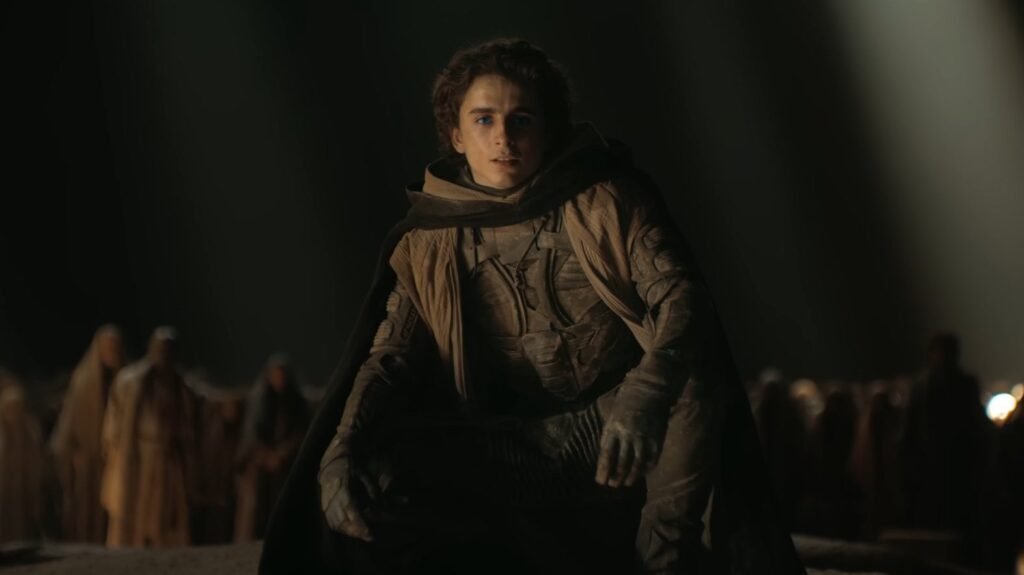
Timothée Chalamet stands out with a performance that balances vulnerability and authority. His transformation feels earned, not forced. You can see the weight of his decisions in his expressions, in the way he carries himself, and in the shift in his tone. However, one aspect that feels slightly underdeveloped is Zendaya’s Chani. While she has a stronger presence compared to the first film, there’s still a sense that her character could have been explored more deeply. Given her importance in the narrative, especially moving forward, the film leaves you wanting more from her — more emotional depth, more influence on Paul’s journey, and more screen time overall. The supporting cast adds further strength, ensuring that even smaller roles feel significant. Each character contributes to the larger narrative without being overshadowed by the film’s scale.
Pacing vs Depth — Where the Film Divides
One of the most noticeable differences between Part One and Part Two is pacing. The first film was incredibly tight, with a structure that kept you fully engaged from beginning to end. There was a constant sense of urgency, even in quieter moments.
In contrast, Dune: Part Two leans more into its world-building and emotional exploration. While this adds depth, it also creates moments where the film feels slower than necessary. Some sequences could have been trimmed without losing their impact.That said, this slower pacing isn’t entirely a flaw. It reflects the film’s shift in focus — from setting up a world to exploring its consequences. The story becomes heavier, more complex, and more layered, which naturally requires more time.
A Sci-Fi Experience That Stays With You
Even with its imperfections, Dune: Part Two stands as one of the most powerful science fiction films of this generation. It doesn’t just rely on spectacle — it combines scale with substance, creating an experience that is both visually stunning and emotionally engaging.
After Interstellar, very few films have managed to create this level of immersion and impact. Dune: Part Two comes incredibly close, if not equal, in terms of ambition and execution. It may not be as tightly written as the first part, but it compensates with its depth, scale, and emotional weight. More than anything, the film leaves you thinking about what comes next. The story doesn’t feel complete — it feels like it’s building toward something even bigger. And that anticipation is what makes the experience even more exciting.