
Complete Book Analysis, Movie Breakdown & Production Details Before You Watch
Few science fiction novels in recent years have generated as much anticipation for a film adaptation as Project Hail Mary by Andy Weir. After the massive global success of The Martian, Weir once again proved that intelligent, science-heavy storytelling can also be deeply emotional and entertaining. With Ryan Gosling set to headline the film adaptation, directed by Phil Lord and Christopher Miller, interest in this project has expanded far beyond the science fiction community. Before watching the film, understanding the novel’s structure, themes, and production background significantly enhances the experience.
At its core, Project Hail Mary is a space survival story, but it is far more layered than that simple description suggests. The novel opens with Ryland Grace waking up alone aboard a spacecraft, with no memory of who he is or how he arrived there. This amnesia-driven opening immediately establishes narrative tension while functioning as a structural device that allows the story to unfold gradually. As Grace regains his memories, readers discover that Earth is facing extinction. A microorganism known as Astrophage is absorbing solar energy from the sun, causing it to dim and threatening global collapse. Humanity’s only hope lies in an interstellar mission to Tau Ceti, where a distant star appears unaffected by Astrophage. Grace is the lone surviving crew member of that mission. While the premise sounds like a conventional high-stakes science fiction thriller, the novel’s true strength lies in its psychological and thematic depth. Grace is not written as a heroic astronaut archetype. He is a former middle school science teacher who transitioned into molecular biology research. He is intelligent, curious, and humorous, but he is also fearful and deeply human. The story eventually reveals that he did not voluntarily sign up for the mission. He was forced into it when circumstances left him as one of the few genetically compatible candidates capable of surviving the induced coma required for interstellar travel. This revelation reframes the entire narrative, shifting it from a tale of chosen heroism to one of reluctant responsibility.
Technically, the novel belongs firmly in the realm of hard science fiction, a genre defined by scientific realism and technical accuracy. Andy Weir meticulously explains orbital mechanics, relativistic travel speeds, energy transfer systems, and microbial astrophysics in ways that remain accessible without sacrificing complexity. Concepts such as mass-energy equivalence, radiation shielding, and metabolic suspension are central to the plot rather than decorative elements. However, the science never overwhelms the emotional core. Instead, it becomes a tool for problem-solving, placing readers directly inside Grace’s thought process as he navigates crisis after crisis using logic and experimentation. The emotional turning point of the novel arrives with the introduction of Rocky, an alien engineer from a distant star system who is on a parallel mission to save his own species. Rocky is one of the most distinctive alien characters in modern science fiction because he is neither antagonistic nor anthropomorphized in a simplistic way.

His physiology is radically different from humans, and his communication relies on musical tones rather than spoken language. The friendship that develops between Grace and Rocky becomes the heart of the story. Their collaboration transcends species boundaries and explores themes of trust, cooperation, and shared survival. The novel ultimately argues that intelligence and empathy are universal qualities, not limited by biology. When adapting such a technically detailed and emotionally layered novel into film, significant challenges arise. The movie adaptation of Project Hail Mary stars Ryan Gosling as Ryland Grace and is directed by Phil Lord and Christopher Miller, filmmakers known for balancing humor with emotional sincerity. The screenplay is written by Drew Goddard, who previously adapted The Martian for the screen with critical and commercial success. This creative team signals a strong commitment to preserving both the scientific credibility and the emotional arc of the source material.
Translating the book’s nonlinear structure to film requires careful editing and pacing decisions. In the novel, flashbacks are seamlessly woven between present-day survival sequences. In cinema, these transitions must be visually coherent and emotionally impactful without confusing the audience. Furthermore, the film must condense lengthy scientific explanations into visual storytelling. While a novel can dedicate pages to describing molecular processes or propulsion systems, a movie must convey these concepts through dialogue, production design, and visual effects. The success of the adaptation will depend largely on how effectively it maintains scientific authenticity while ensuring narrative momentum. From a production perspective, the film demands a high level of technical precision. The design of the Hail Mary spacecraft must reflect plausible engineering rather than fantastical aesthetics. The interior sets need to feel functional, grounded, and influenced by real-world space agencies such as NASA and ESA. Additionally, rendering Rocky convincingly presents a major visual effects challenge. His non-humanoid anatomy and unique environmental requirements must appear believable without drifting into cartoonish territory. The filmmakers must also visualize Astrophage in a way that communicates both its microscopic nature and its cosmic-scale consequences. Ryan Gosling’s involvement extends beyond acting, as he also serves as a producer on the project. This dual role often indicates deeper creative investment and long-term confidence in the material. Gosling’s previous performances suggest he is capable of portraying introspective, emotionally layered characters, which aligns well with Grace’s psychological journey. The character is not driven by physical bravado but by intellectual persistence and emotional growth. Capturing that nuance on screen is essential to preserving the integrity of the story.
Ultimately, Project Hail Mary is not simply about stopping a dying star. It is about confronting fear, accepting responsibility, and choosing courage even when it is inconvenient or terrifying. Grace begins the story prioritizing survival over sacrifice, but through his experiences and his bond with Rocky, he evolves into someone willing to risk everything for another being. This transformation gives the narrative its emotional resonance and distinguishes it from many conventional space thrillers. For audiences preparing to watch the film, understanding these thematic foundations enriches the viewing experience. The spectacle of interstellar travel and advanced technology will undoubtedly draw viewers in, but the lasting impact comes from the human dimension. The novel demonstrates that scientific problem-solving and emotional vulnerability are not opposites but complements. Intelligence alone does not save the day; growth does. With a proven creative team, a committed lead actor, and source material grounded in rigorous science and heartfelt storytelling, the adaptation of Project Hail Mary carries significant potential. If executed faithfully, it could stand alongside the most respected science fiction films of the decade. Before stepping into the theater, recognizing that this story is as much about friendship and redemption as it is about astrophysics allows viewers to appreciate the full depth of what unfolds on screen.
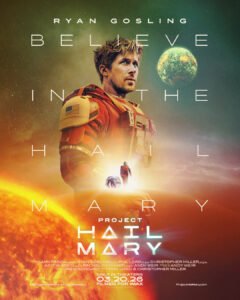 Project Hail Mary releases in theatres on March 20, 2026.