Review
Few films manage to capture the quiet poetry of everyday life the way Roma (2018) does. From the very first frame, Alfonso Cuarón establishes a tone that feels deeply personal and meticulously crafted. I’ve rarely seen an opening as brilliant as the one in Roma. It’s simple, almost meditative, yet it instantly reveals the film’s confidence in its visual storytelling. That opening shot alone signals that what follows is not just a narrative film but a cinematic experience built on patience, observation, and emotional honesty. What makes Roma so powerful is its commitment to realism. Cuarón recreates 1970s Mexico City with extraordinary attention to detail, immersing the audience in a world that feels authentic and lived-in. The film quietly unfolds through the daily routines of Cleo, a domestic worker caring for a middle-class family. Rather than relying on dramatic plot twists, the film builds its emotional weight through small, intimate moments.
The cinematography is easily the film’s most striking element. Shot entirely in black and white, the visuals create a beautiful contrast between light and shadow. The deep blacks and carefully controlled lighting give each frame a painterly quality, making the film feel almost like a moving photograph. Cuarón’s camera movements are deliberate and patient, often using slow pans and long takes that allow the viewer to absorb every detail within the frame. These long takes are not simply stylistic choices; they become part of the film’s storytelling language. Instead of cutting rapidly between shots, the camera glides through spaces, capturing multiple layers of action within a single frame. This approach allows the audience to observe the environment just as much as the characters themselves.
The production design is equally impressive. From the streets of Mexico City to the interior of the family’s home, every location feels historically accurate. The costumes, vehicles, and background details recreate the social atmosphere of the 1970s with remarkable authenticity. The film does not merely depict a period; it immerses the viewer inside it. What makes Roma feel particularly special is how it balances its visual beauty with emotional depth. The film slowly reveals the struggles faced by Cleo, whose life quietly unfolds in the background of the family she serves. Her personal hardships, combined with the broader social tensions surrounding Mexico at the time, create a layered narrative that feels both intimate and political.
By the end of the film, it becomes clear that Roma is more than just a story about a household. It is a meditation on memory, class, love, and sacrifice. Watching it feels like experiencing a cinematic diary — one that captures the fragile beauty of ordinary moments.
Watch the official trailer of ‘Roma’
Breakdown
Beyond its emotional storytelling, Roma is a fascinating film when examined through its structure and themes. The film is largely autobiographical, inspired by Alfonso Cuarón’s own childhood. Cleo’s character is based on the woman who cared for Cuarón during his early years, which explains the film’s deeply personal tone. At the center of the narrative is Cleo’s relationship with the family she works for. Although she is technically an employee, she becomes emotionally intertwined with the household. The film quietly explores this complex dynamic, highlighting the blurred boundaries between affection and social hierarchy.
Another key element of the film is its depiction of Mexico’s political climate during the early 1970s. While the story primarily focuses on Cleo’s personal experiences, historical events occasionally enter the narrative in subtle yet powerful ways. One of the most striking examples is the Corpus Christi massacre, which unfolds during a chaotic street sequence. This moment connects the characters’ personal struggles with the larger political tensions of the time. Cuarón also uses visual storytelling to reinforce the film’s themes. Many scenes are framed with wide compositions that allow multiple events to unfold simultaneously. For instance, the camera might follow Cleo performing a simple task while important background actions occur elsewhere in the frame. This technique reflects how life itself often unfolds — quietly and unpredictably. Water also becomes an important visual motif throughout the film. From the opening shot of water washing over the ground to the emotional beach sequence later in the story, water represents both memory and emotional release. It appears at moments when characters confront their deepest fears or vulnerabilities.
The slow pacing of the film may initially feel unusual for viewers accustomed to fast-moving narratives. However, this deliberate pacing is essential to the film’s immersive quality. Instead of rushing through events, Cuarón allows the audience to sit with each moment, creating a deeper emotional connection with the characters.
Climax Explained
The emotional climax of Roma takes place during the beach sequence, which is one of the most powerful scenes in modern cinema. As the family visits the coast, the children are suddenly caught in strong ocean currents. Cleo, despite not knowing how to swim, rushes into the water to save them. The sequence is shot with remarkable restraint. Instead of dramatic music or rapid editing, Cuarón relies on a single extended shot that captures the terrifying unpredictability of the waves. The scene feels raw and immediate, placing the audience directly inside the moment.
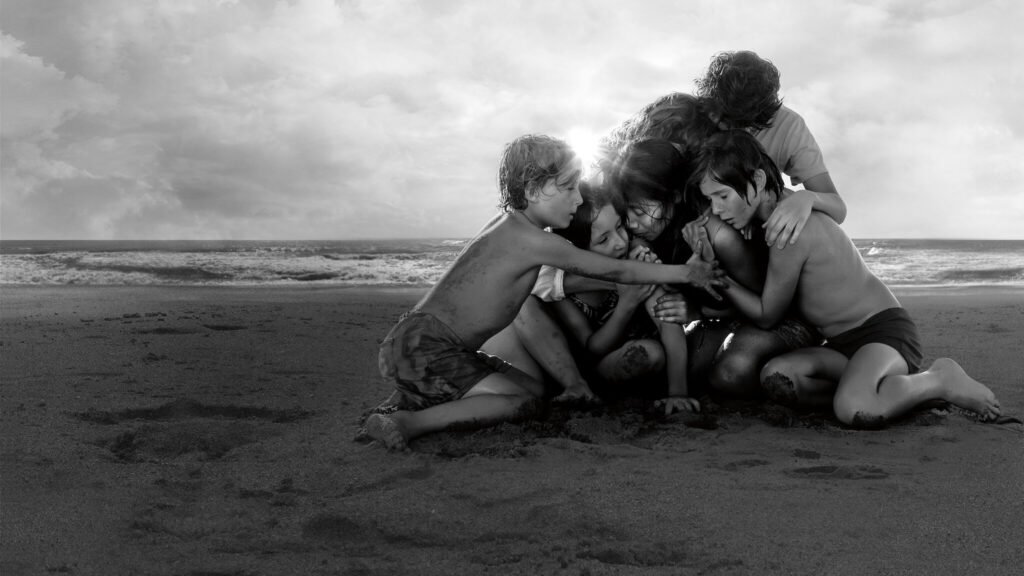
After rescuing the children, Cleo collapses on the beach and confesses something deeply painful , she admits that she did not want her baby to be born. This confession reveals the immense emotional burden she has been carrying throughout the film. Her grief, guilt, and exhaustion finally surface in a moment of vulnerability. The family gathers around Cleo in a quiet embrace, creating one of the most emotionally powerful moments in the film. It is not simply a moment of relief but a moment of recognition. For the first time, Cleo’s emotional struggles are fully acknowledged.
The beach scene ultimately serves as a turning point in the narrative. It brings together the film’s themes of motherhood, sacrifice, and emotional connection. By risking her life to save the children, Cleo demonstrates a profound love that transcends the boundaries of her role within the household.
Why Roma Feels Like a Cinematic Textbook
One reason Roma is so widely admired is that it functions almost like a textbook for filmmaking. The film demonstrates how cinematography, sound design, and storytelling can work together to create a deeply immersive experience. Every frame feels intentionally composed, every movement of the camera carefully considered.
For aspiring filmmakers and cinema lovers alike, Roma offers an extraordinary example of visual storytelling. It proves that powerful cinema does not require constant action or spectacle. Instead, it can emerge from the quiet observation of life itself.Cuarón’s ability to transform personal memory into universal storytelling is what ultimately makes Roma unforgettable. The film feels both deeply specific to its setting and universally relatable in its exploration of human relationships.